The Car With No Transmission
Inside the Patent-Pending Vimana CP-17 — and the Drive Architecture That Could Rewrite the Automobile
For more than a century, the automobile has improved without ever fully escaping its original mechanical logic.
Engines became more powerful.
Transmissions gained more gears.
Differentials became smarter.
Brakes became larger.
Electronics took over functions that used to be mechanical.
Electric vehicles removed the combustion engine, but much of the familiar drivetrain logic remained:
Generate rotation.
Transmit it mechanically.
Divide it mechanically.
Control it mechanically.
Then throw much of the vehicle’s kinetic energy away as heat every time the driver stops.
The Vimana CP-17 begins with a different question.
What if the future of the automobile is not a better transmission?
What if it is no transmission at all?
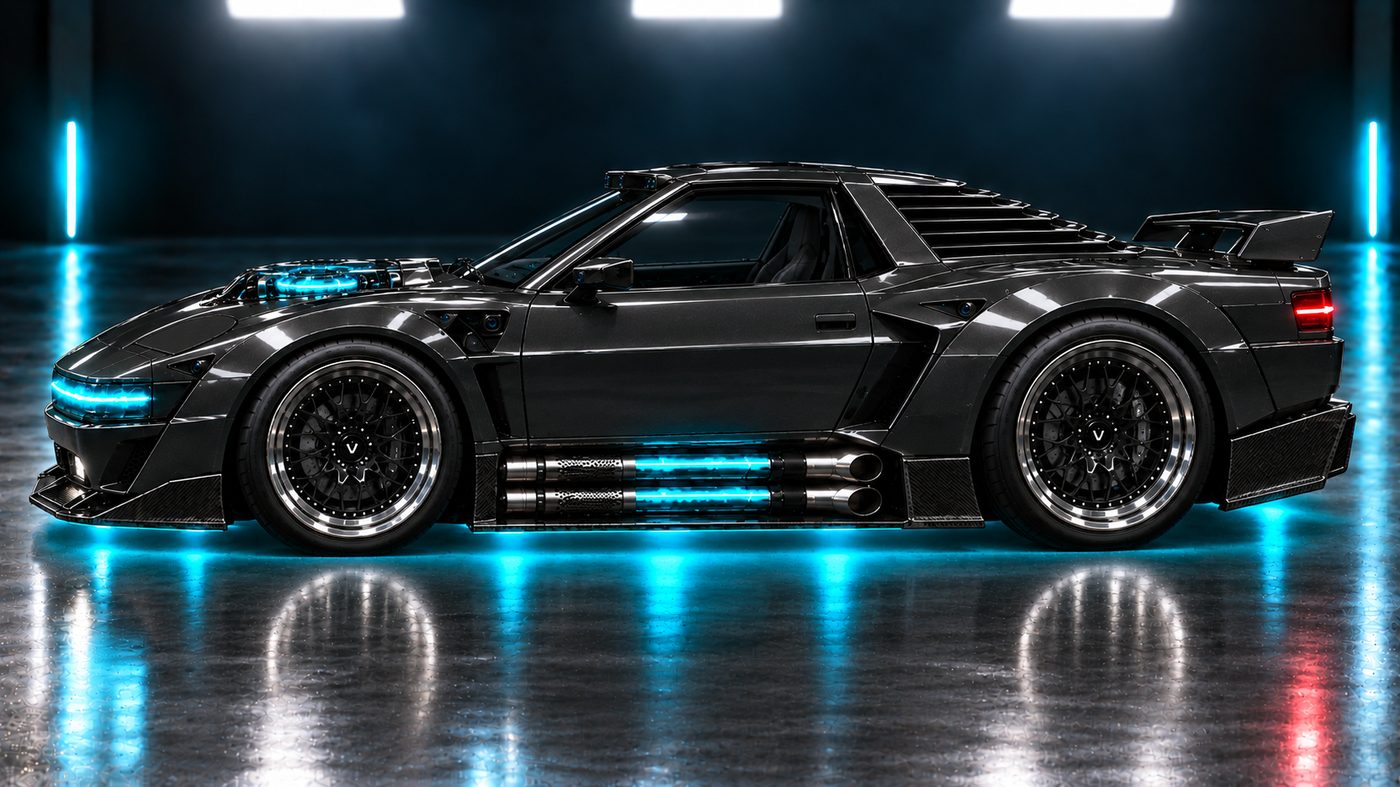
The CP-17 is a proposed phase-coherence performance vehicle built around the PCE-41 architecture. Its propulsion system, exterior, and AEON cockpit are conceived as parts of one machine—not separate systems bolted together afterward.
The program is at the concept stage. It is intended to be built, tested, challenged, and refined.
But the proposition is radical.
Remove the transmission.
Remove the mechanical differential.
Move routine braking away from friction.
Reduce the mechanical chain between energy generation and wheel motion.
That is not another iteration of the automobile.
That is an attempt to change what an automobile is.
Stop Shifting Gears
A conventional transmission exists because an engine cannot efficiently provide every combination of wheel speed and torque directly.
First gear provides leverage.
Higher gears trade torque multiplication for speed.
A transmission spends its life mechanically moving between those compromises.
The CP-17 proposes something different: Topological Gear Selection.
Rather than shifting physical gears, each driven wheel carries a Phase Lock Receiver designed to couple to the appropriate harmonic regime in the PCE-41 cascade.
Need strong low-speed torque?
Couple to a lower harmonic regime.
Need high-speed cruising?
Retune to a higher one.
The effect is similar to changing gears.
The mechanism is not.
No physical gear stack changes engagement.
No clutch pack waits to wear out.
No torque converter transfers power through fluid.
No conventional shift event interrupts the drive.
The “gear change” is a change in resonance.
The Vimana proposition is simple:
Stop shifting gears.
Change the state of the wheel instead.
No Mechanical Differential
Every conventional mechanically driven axle faces the same geometric problem in a turn.
The outside wheel travels farther than the inside wheel.
Mechanical drivetrains solve that problem with differentials, clutch packs, torque-vectoring systems, and increasingly complicated control hardware.
The CP-17 is designed around four independently controllable wheel receivers.
Each wheel can be assigned a different coupling state.
During a turn, the inside wheel can reduce coupling while the outside wheel maintains or increases it.
The resulting torque difference produces the required yaw behavior.
Nothing needs to mechanically split power because the architecture does not assume that all four wheels must receive power through one mechanically divided source.
The differential is not replaced by a more complicated differential.
It becomes unnecessary as a mechanical category.
That means fewer gears.
Fewer housings.
Fewer lubrication requirements.
Fewer conventional failure points.
Braking Without Waste
The brake may be the clearest example of old automotive thinking.
A conventional car has kinetic energy.
The driver wants to stop.
So brake pads clamp a rotor and turn motion into heat.
Then the heat disappears into the atmosphere.
Electric vehicles improved that model with regenerative braking. Some energy can be recovered through motor-generator and battery pathways.
The CP-17 proposes another approach.
Its Coherence Brake is designed around phase inversion.
During propulsion, the wheel couples to the drive cascade and receives energy.
During braking, that relationship reverses.
The wheel’s kinetic energy is designed to couple back toward the resonant system and into high-Q storage for reuse.
The question changes from:
How efficiently can we convert braking energy into another form?
To:
Why convert it so many times at all?
The concept does not pretend that a vehicle needs no fail-safe braking system. Conventional friction brakes remain part of the safety architecture.
But routine stopping would no longer need to depend primarily on pads, rotors, heat, and wear.
Less brake dust.
Less pad wear.
Less thermal fade.
Less kinetic energy deliberately discarded as heat.
On Without Idling
At a red light, a combustion engine idles or shuts down.
An electric drivetrain waits in a ready state.
The CP-17 proposes Standing-Wave Idle.
The PCE-41 maintains its harmonic cascade.
The wheel receivers simply detune so they no longer couple to it.
The energy structure remains available.
The wheels do not respond.
When propulsion is requested again, the receiver returns to the required phase-lock condition.
No conventional ignition.
No clutch engagement.
No gearbox selecting first.
No engine climbing from idle into its useful operating range.
The power architecture was never asleep.
The wheels simply stopped listening.
The Engine Defines the Body
The CP-17 is not designed to hide its architecture under cosmetic panels.
The proposed vehicle uses a low PCE-41 containment crown rather than a conventional exposed engine block, preserving the driver’s sightline.
Its exterior identity follows the same logic.
Geometrically reinforced alloy.
Modular fabrication.
Teal plasma channels.
Four independently controlled electromagnetic nozzle modules at the rear.
Not decorative exhaust tips.
Part of the proposed propulsion architecture.
The containment crown, side-rail plasma bypass, thermal-management loop, passenger cell, and nozzle bank are conceived as one integrated system.
The engine defines the body.
The Windshield Becomes the Interface
The same philosophy extends inside the car.
The proposed AEON cockpit turns the windshield into the primary interface.
Road-aligned navigation, hazard information, and vehicle-state data appear at optical depth while a protected central sightline keeps the driver’s view of the real world clear.
The machine should not require the driver to look away from the road to consult a dashboard screen.
The machine should meet the driver within the road environment itself.
Again, the question is not:
What feature can we add?
It is:
What function does this component serve?
Then redesign the function from first principles.
Seven Inventions, One Architecture
The CP-17 architecture brings together seven connected concepts:
- Harmonic Cascade Drive
- Phase Lock Receiver
- Topological Gear Selection
- Coherence Brake
- Phase-Vectored Steering
- Standing-Wave Idle
- The integrated Vimana vehicle architecture
Together, they propose a vehicle in which power distribution becomes a question of coherence and phase rather than gears, shafts, clutches, and mechanical torque splitting.
If the architecture performs as designed, the consequences are enormous.
Factories change.
Service changes.
Packaging changes.
Weight distribution changes.
Maintenance changes.
Energy management changes.
Vehicle dynamics change.
The idea of what belongs between an engine and a wheel changes.
That is why the Vimana CP-17 is not simply a sports car concept.
The body is the demonstration platform.
The architecture is the invention.
Now Build It
The Vimana CP-17 is not in a showroom.
It is not on a racetrack.
The PCE-41 is not yet a production engine.
This is a proposed, patent-pending architecture intended to be built, tested, and refined.
That does not diminish the idea.
It defines the next step.
Put the PCE-41 on a bench.
Build the receiver.
Measure the coupling.
Command the harmonic transition.
Load the Coherence Brake.
Put four receivers around a chassis.
Then put the chassis on a dynamometer and ask the only question that ultimately matters:
Does the machine do what the architecture says it can do?
Because if it does, we are not talking about another drivetrain improvement.
We are talking about removing some of the most fundamental mechanical systems the automobile has carried for more than a century.
No conventional transmission.
No mechanical differential.
No routine dependence on friction braking.
Fewer mechanical failure points.
Less wasted energy.
A fundamentally different relationship between engine and wheel.
The future of the automobile may not have more gears.
It may have none at all.